high-achieving singles Archives - The Crush Confidential

Are Matchmakers Making a Comeback? The 2026 Data

Are matchmakers making a comeback? The short answer is yes, and the numbers behind it are more specific than most people expect.

Two things are happening at once. Dating apps are losing paying users, while professional matchmaking keeps growing. Below is what the 2026 data actually says, along with what it means if you are still swiping.

Woman unhappy scrolling on a dating app.

The Apps Are Losing Paying Customers

Match Group owns Tinder, Hinge, Match, OkCupid, and Plenty of Fish. As a result, its earnings reports work as a rough proxy for the whole category.

In the second quarter of 2026, Match Group reported revenue of $853 million, which fell 1% year over year. More telling, total paying users dropped 6% to 13.3 million. Tinder alone lost 5% of its payers, landing at 8.5 million.

Meanwhile, revenue per payer climbed 6% to $21.13. In plain terms, the apps are charging more money to fewer people.

That pattern matters. Tinder’s monthly active users have now declined for more than three years, and management does not expect payers to return to growth until late 2027. Furthermore, Tinder’s registrations grew just 1% in March, the first increase since 2024.

Hinge remains the exception, with revenue up 22% and monthly active users up 13%. Still, one growing brand does not offset a shrinking base across the rest of the portfolio.

Burnout Is Nearly Universal

The financial numbers reflect something users have been saying for years.

A Forbes Health survey of 1,000 American dating app users found that 78% feel emotionally, mentally, or physically exhausted by the apps at least sometimes. Notably, women reported higher burnout than men, at 80% compared with 74%.

Pew Research adds a sharper detail. Among people who used dating apps within the past year, roughly 88% of men and 90% of women said they often or sometimes felt disappointed by the people they encountered.

Nearly everyone on these platforms feels let down by them. Because of that, the exhaustion is not a personal problem. It is the default experience.

A happy couple that met through matchmaking.

Meanwhile, Matchmaking Keeps Growing

Now compare that to the other side of the industry.

The U.S. matchmaking service market was valued at roughly $3.0 billion in 2025 and is projected to reach $5.2 billion by 2033, at a compound annual growth rate near 7.4%. Across North America, the market sits at approximately $4.5 billion and is forecast to hit $7.8 billion over the same period.

Industry analysts also report growth near 9.5% specifically in premium matchmaking services, the segment serving high-net-worth and high-achieving clients.

So one model is shrinking its user base while raising prices. The other is expanding.

Why the Shift Is Happening

The apps solved the meeting problem. Consequently, that problem no longer needs solving.

What they never addressed is everything after the introduction. Nobody interprets the mixed signal you got on Tuesday. No one tells you why three connections in a row went quiet at the same point. Above all, no one gives you honest feedback, because the person who lost interest simply stops replying.

Volume was the entire value proposition. However, volume turned out to be the problem rather than the solution.

Pew found that only about one in ten partnered adults met their current partner through a dating site or app. Billions of swipes have produced a fairly modest hit rate.

What Matchmaking Adds

A professional matchmaker changes three variables that apps leave untouched.

Screening happens before you invest time. Someone verifies identity, intent, and readiness in advance. Therefore you spend your evenings on qualified people instead of on discovery.

Feedback replaces guessing. After each date, you learn what actually happened rather than inventing an explanation for silence.

Support continues past the introduction. This is the piece most of the industry still misses. Traditional matchmaking makes a connection and steps back, which leaves both people alone during the most fragile stage of a new relationship.

That last point is why we built our proprietary 3-Date Model. First dates measure nerves, while second and third dates measure compatibility. When someone guides clients through that window, premature endings drop sharply.

We call the broader approach relationship curation, and TIME recently covered it.

What This Means for You

The data does not say dating apps are useless. Millions of people still meet on them every year.

Instead, the data says something more precise. If you are over forty, serious about a long-term relationship, and short on time, then the app model is working against your specific goals. You are optimizing for volume in a situation that rewards depth.

The comeback is real because the alternative stopped working for a large group of people. Matchmaking is not nostalgia. Rather, it is a different structure for a different objective.

Where to Start

We work with commitment-minded singles nationwide who are finished with apps and ready to date with structure and support.

Apply for matchmaking: Two Ways to Work With Us

Not ready to become a client? Add your profile to the Singles Rolodex at no cost. That is how we source matches for our clients.

See the outcomes: Our Success

Why Successful People Are the Worst at Dating

Successful people dating in their forties, fifties, and sixties share one specific frustration. They built companies, raised children, and now lead teams, close deals, and manage risk for a living. Yet across the table at dinner, they feel completely out of their depth.

In fact, the traits that built your career often work against you romantically.

Here is why.

Successful man stressed about dating.

1. You Are Used to Being Good at Things Immediately

High achievers rarely stay bad at something for long. Because you learn fast, course-correct, and move on, incompetence never lasts.

Dating, however, rewards none of that. No certification exists, no clear metric applies, and no one hands you a scorecard. Furthermore, studying harder never removes the discomfort of not knowing whether someone likes you.

So most high performers quietly disengage and blame their calendar.

2. You Optimized Everything Else, and Dating Punishes Optimization

Efficiency built your career. Over the years, you cut what did not produce, delegated what did not require you, and defended your calendar aggressively.

Naturally, the same instinct shows up on a first date. You screen hard, decide fast, and cut anyone who fails to show obvious upside within ninety minutes.

The trouble is that early dating produces almost no reliable data. Nerves and expectation distort a first date, because both people perform. As a result, an efficient decision usually becomes the wrong decision.

Of course, efficiency serves you well in business. Here, though, it works against you.

3. Nobody Gives You Honest Feedback Anymore

Successful people operate inside a distortion field. Employees soften bad news, while friends stay supportive. Meanwhile, a date who loses interest says nothing at all and simply stops responding.

Consequently, the feedback loop breaks. One habit may end your connections again and again, and no one has ever named it.

To be clear, this reflects no character flaw. Rather, it exposes a structural blind spot, and blind spots never correct themselves. Someone has to say it out loud.

A successful couple.

4. You Delegate Everything Except This

Most high achievers keep an accountant and an attorney on call. In addition, many hire a trainer, an assistant, a financial advisor, and a contractor.

Yet one area stays entirely in your own hands, and it happens to carry the highest impact on your quality of life.

Why? Because dating feels like it should come naturally, hiring help feels like failure. In reality, the same logic applies here that you already trust everywhere else. That is, bring in a professional wherever the stakes run high and your own perspective runs short.

5. Your Competence Reads as Distance

Decisiveness, containment, and command of a room signal authority in a boardroom. On a second date, however, that same energy reads as unavailable.

Warmth demands a kind of exposure most executives spent decades learning to avoid.

This pattern ranks among the most common we see, and also among the most fixable. Personality rarely causes the problem. Instead, the problem comes down to which mode you run in and whether you can switch.

What Actually Works

None of this means you are bad at relationships. Instead, it means a high-performance operating system is running a situation with different rules.

Three adjustments fix most of it.

Give the connection more than one meeting. First dates measure nerves, while second and third dates measure compatibility. That is the entire premise of our proprietary 3-Date Model: never judge from the least informative data point.

Get honest input from someone with no stake in flattering you. Real feedback after every date, in other words, rather than encouragement. Most people have gone years without it.

Stop treating dating as a solo project. After all, you would never handle your own legal work. No reason exists to handle this alone either.

Where to Start

We work with commitment-minded singles nationwide who are done with apps and ready to date with structure and support.

Apply for matchmaking: Two Ways to Work With Us

Not ready to become a client? Add your profile to the Singles Rolodex at no cost. That is how we source matches for our clients.

See what this looks like when it works: Our Success


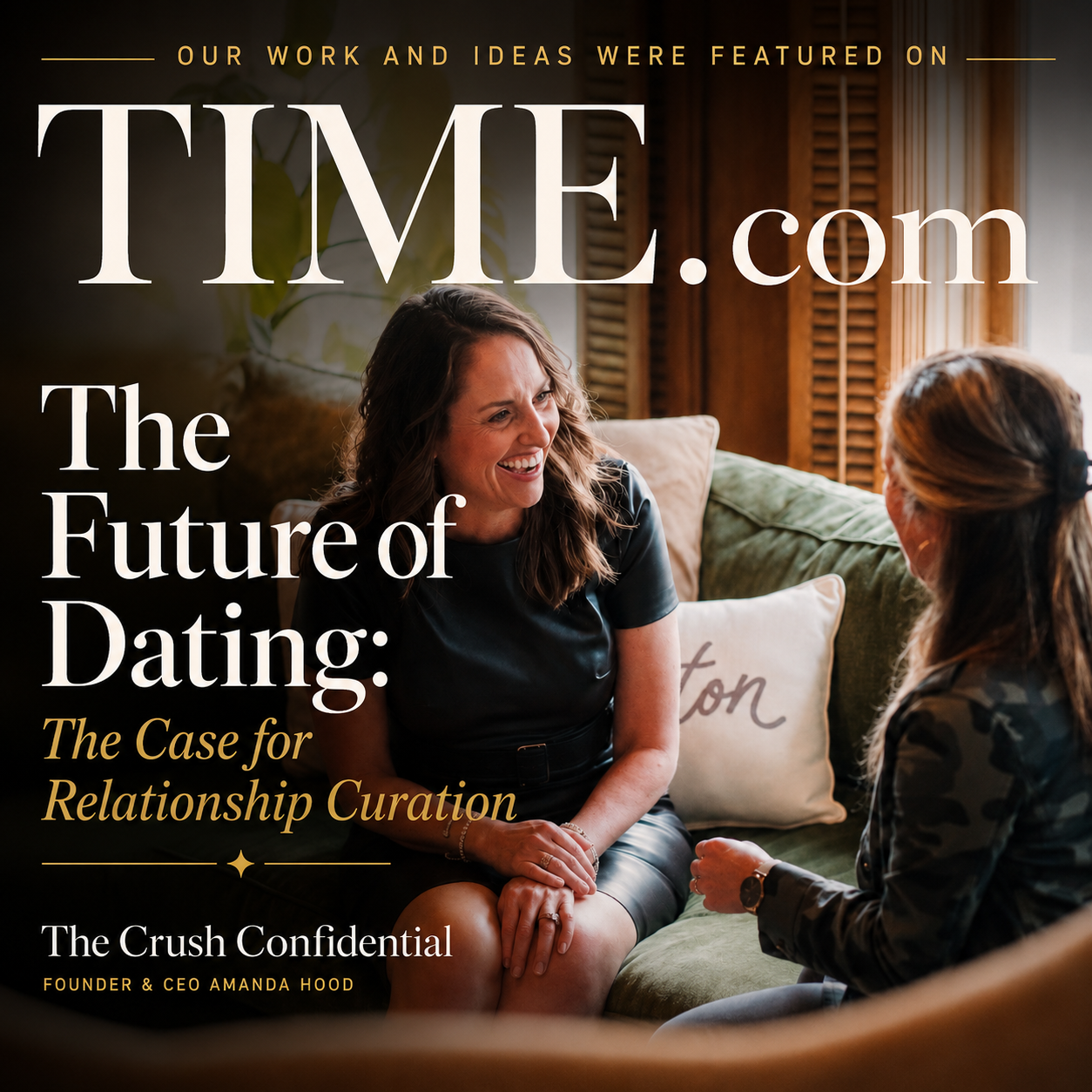
Featured in TIME: Why Relationship Curation Is the Future of Dating

The Crush Confidential was recently featured in TIME for our work in relationship curation. The piece examined a question that drives everything we do: why has dating become easier than ever, while relationships have become harder to build?

You can read the full feature here: The Future of Dating: The Case for Relationship Curation

Below is the short version, plus what it means for anyone currently dating.

Access Went Up. Clarity Did Not.

Technology solved the meeting problem. Apps put thousands of people in front of you. Social platforms extended your reach far past your zip code. That part works.

The part that never got solved is what happens after the introduction.

Most accomplished singles are not struggling to get a first date. They are struggling to turn a first date into a relationship. That gap is where the exhaustion comes from, and it is not a personal failing. It is a design flaw in how the entire industry operates.

Why Introductions Alone Are Not Enough

Traditional matchmaking has one output. Two compatible people meet, and the matchmaker steps back.

The assumption is that compatibility will surface on its own. In practice, it often does not. The first few weeks of a new connection are the most fragile stage of the entire relationship, and that is precisely the stage where most clients are left alone.

We built The Crush Confidential around a different conviction. Chemistry needs structure. That is what relationship curation provides.

What Relationship Curation Actually Means

Relationship curation means a relationship professional stays involved through the early development of the connection, not just the introduction.

In practice, that includes:

  • Interpreting communication patterns before they get misread

  • Managing expectations on both sides

  • Coaching clients through uncertainty instead of letting them guess

  • Providing real-time feedback between dates

The goal is not to force an outcome. The goal is to remove the avoidable friction that ends viable connections before they have a chance to become real.

The 3-Date Model

Our proprietary 3-Date Model is the framework behind this.

First dates are shaped by nerves and expectation. They tell you very little about how two people will actually relate to each other. By the second and third date, communication loosens, and the real signal appears.

Most modern dating culture pushes people to decide after one meeting. The 3-Date Model pushes back on that. When clients are guided through this phase rather than left to navigate it alone, premature endings drop significantly.

Ghosting Is a Skill Gap, Not a Character Flaw

Ghosting gets treated as a personality problem. We treat it as a structural one.

Digital communication made disappearing easier than having one uncomfortable conversation. Nobody was ever taught how to close a connection cleanly, so they default to silence.

Our clients learn how to handle early ambiguity directly. They also learn how to respond when it happens to them.

Better Matches, Better Daters

Every engagement at The Crush Confidential is tailored. There is no template.

Coaching is woven in from day one, because the objective is not only to introduce you to compatible people. It is to make you a stronger partner. Clients leave with sharper self-awareness and with dating patterns broken that had been quietly costing them for years.

The Future of Dating

Algorithms will keep improving. AI will keep optimizing profiles and predicting behavior.

None of that touches the part that actually determines whether a relationship survives: communication, timing, and the willingness to stay present through uncertainty. Those remain human. They also remain teachable.

That is the work.

If You Are Ready for Something Real

We work with commitment-minded singles nationwide who are done with apps and ready to date with structure.

Explore how we work: Work With Us

Not ready to become a client? Add your profile to our Singles Rolodex at no cost. It is how we source matches for our paying clients.

See the results: Our Success