relationship advice Archives - The Crush Confidential

Modern Dating Terms You Need to Know in 2025: A Guide to Today’s Relationship Language

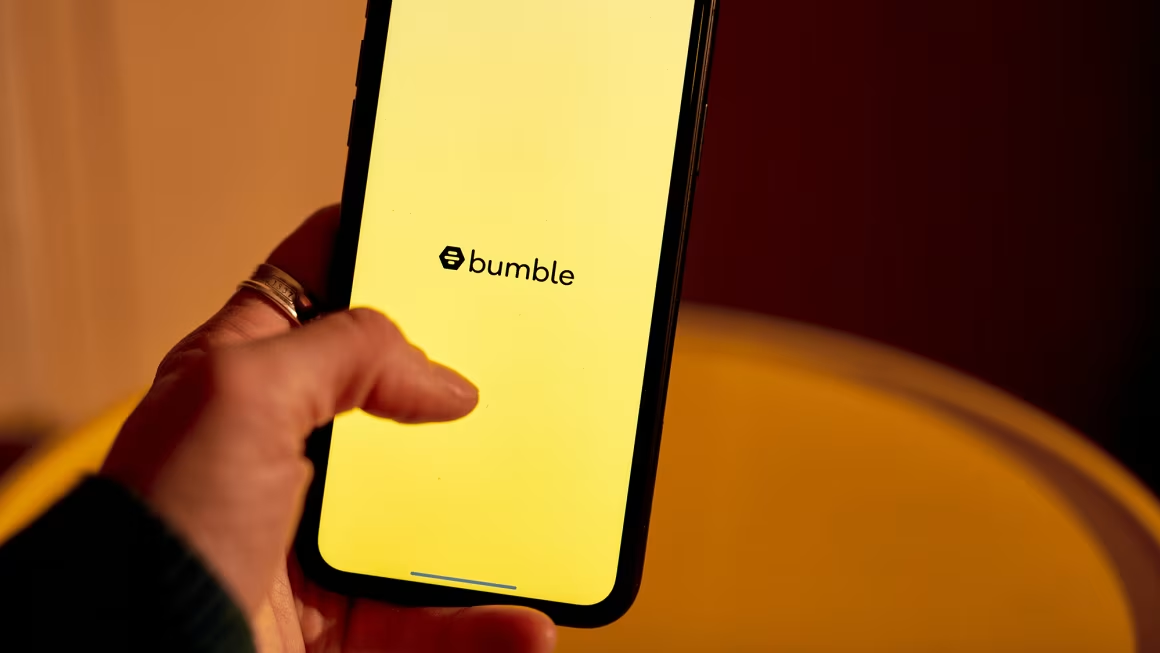
Person looking at their phone while navigating modern dating apps and terminology.

Modern dating moves fast—and so does the language around it. New terms seem to pop up every time you open Instagram, TikTok, or your favorite dating app. As Amber Samuels, Ph.D., notes, this shared vocabulary creates connection and helps people make sense of the experiences they’re navigating.

At The Crush Confidential, where we guide singles through today’s ever-evolving dating culture, we see firsthand how helpful this modern “dictionary” can be. Below is your A-to-Z breakdown of the most popular dating terms in 2025—what they mean, why they matter, and how understanding them can improve your approach to love.


Affordating

Affordating refers to choosing low-cost or budget-friendly date ideas without compromising the quality of the experience. It reflects the growing trend toward mindful spending and intentional connection.


Benching

Benching happens when someone keeps a romantic interest “on the sidelines” while actively pursuing other people. They maintain occasional contact—just enough to keep the person interested—without committing to anything meaningful.


Breadcrumbing

Breadcrumbing involves sending minimal, inconsistent signals of interest (like sporadic texts or likes) to keep someone emotionally hooked without progressing toward an actual relationship.


Catfishing

Catfishing is when a person pretends to be someone else online by using fake photos or misleading information. This can range from minor image editing to creating entirely fabricated identities.


Conscious Uncoupling

Conscious uncoupling is a thoughtful, respectful approach to ending a relationship. It prioritizes clear communication, emotional closure, and reducing harm for both people involved.


Cuffing Season

Cuffing season describes the fall and winter months when many people seek temporary relationships or companionship. These connections may or may not last beyond the season.


DINK

DINK stands for “dual income, no kids” and refers to couples who both earn income and have chosen (temporarily or long-term) not to have children.


DTR

DTR means “define the relationship.” It’s the conversation where two people clarify what they are — dating, exclusive, serious, casual, or somewhere in between.


50/50

“50/50” is the debate about how equally partners should split finances, chores, and responsibilities in a relationship. The term often comes up when discussing fairness and expectations.


FLR

FLR stands for “female-led relationship,” where the woman takes a more prominent role in decision-making, finances, structure, or leadership within the relationship.


FWB

FWB, or friends with benefits, describes two friends who maintain a friendship while also engaging in physical intimacy without a romantic commitment.


Gaslighting

Gaslighting is a form of manipulation where one person causes the other to doubt their memory, perception, or reality. It often involves denial, blame-shifting, or trivializing emotions.


Ghosting

Ghosting is abruptly cutting off all communication without explanation. The person receiving the silence is left without closure, clarity, or understanding of what went wrong.


Green Flags

Green flags are positive signs — consistency, communication, emotional safety, reliability — that indicate someone has healthy qualities suitable for a relationship.


Hard Launch

A hard launch is a clear, public announcement of a new relationship on social media, typically revealing a partner’s face, name, or the relationship status directly.


The Ick

The ick is a sudden feeling of discomfort or repulsion toward someone you were previously interested in. It’s often triggered by a specific behavior or moment.


Love Bombing

Love bombing is overwhelming someone with affection, gifts, compliments, or attention early in dating. It can be genuine in rare cases, but often it is manipulative or rooted in insecurity.


Micro-Cheating

Micro-cheating refers to small behaviors that cross emotional boundaries, such as flirty messages, secret interactions, or maintaining dating profiles while in a relationship.


Negging

Negging involves giving someone backhanded compliments or subtle insults to undermine their confidence and increase their desire for approval from the person delivering them.


Orbiting

Orbiting is when someone ends communication but continues watching your stories, liking your posts, or engaging with your social media. They stay “in your orbit” without actual contact.


Red Flags

Red flags are warning signs that a person or relationship may not be healthy — disrespect, inconsistency, hot-and-cold behavior, poor communication, dishonesty, or boundary violations.


Rizz

Short for charisma, rizz describes someone’s ability to charm, flirt, or attract others through personality, confidence, or presence.


Ship

Short for “relationship,” to “ship” someone is to support or encourage two people becoming a couple — whether fictional characters or real individuals.


Situationship

A situationship sits between casual dating and a relationship — emotional or physical closeness without clear commitment, labels, or expectations.


Slow Fade

A slow fade is a gradual withdrawal of communication or effort instead of an abrupt ghosting. Messages become less frequent, plans decline, and interest fades without explanation.


Soft Launch

A soft launch is a subtle social-media reveal of a relationship, such as posting a partner’s hand, shoes, or a dinner date angle that hides their identity.


Soulmate

A soulmate describes someone with whom you share a deep emotional, romantic, or spiritual connection — often feeling natural, aligned, and meaningful.


Talking Stage

The talking stage is the early phase where two people get to know each other before committing. It can include texting, flirting, and early dates while deciding if a relationship is possible.


Twin Flame

A twin flame refers to an intense spiritual connection believed to represent two halves of the same soul — often passionate, challenging, and transformational.


Zombieing

Zombieing is when someone who ghosted suddenly reappears, acting as though nothing happened — resurfacing with a “Hey stranger” message or unexpected contact.

Final Thoughts

Modern dating comes with its own language, and knowing these terms isn’t just about staying current—it’s about understanding the emotional landscape of relationships today. When you can identify patterns like breadcrumbing, orbiting, or slow fades, you’re better equipped to protect your heart and advocate for what you truly want. And when you recognize green flags, healthy communication styles, and aligned values, you can move toward connection with confidence instead of confusion.

At The Crush Confidential, we see countless singles who feel overwhelmed by the complexities of dating culture—especially those navigating the endless loop of apps, situationships, and mixed signals. What many don’t realize is that modern dating language often reflects modern dating pain points. By naming the experience, you take back control of it.

Our mission is to guide you toward something far more meaningful than trendy terminology: real partnership, genuine compatibility, and the kind of connection that isn’t dependent on timing, swipes, or seasonal flings. Through thoughtful vetting, intentional matching, and ongoing support, we help our clients move out of uncertainty and into clarity. Whether you’re recovering from a zombie, tired of the talking stage, or ready to graduate from situationships altogether, you don’t have to navigate today’s dating landscape alone.

Love may evolve, but the desire for a deep, lasting relationship never goes out of style. If you’re ready for a more intentional, curated approach to dating—one rooted in values, alignment, and authenticity—The Crush Confidential is here to guide your journey every step of the way.

What Your Attachment Style Says About Your Love Life

Couple holding hands over coffee, representing secure attachment and emotional connection.

When it comes to love, how you connect can be just as important as who you connect with. Understanding your attachment style can help you recognize patterns, improve communication, and ultimately build stronger, more fulfilling relationships.

At The Crush Confidential, we see this play out every day — from first introductions to long-term matches. Whether you’re anxiously checking your phone after a first date or tend to keep your guard up for too long, your attachment style can reveal valuable insights into your dating habits and emotional needs.


The Four Main Attachment Styles

Researchers in psychology have identified four key attachment styles that influence how we relate to others romantically.

1. Secure Attachment
If you have a secure attachment style, you likely feel comfortable with closeness and independence. You communicate openly, trust easily, and handle conflict with maturity. People with this style tend to thrive in long-term relationships because they aren’t afraid of emotional intimacy.

Tip: Keep leading with authenticity — and if you’re single, know that your confidence and emotional availability are deeply attractive qualities.

2. Anxious Attachment
Anxiously attached individuals crave closeness but often worry about being abandoned or rejected. You might overthink messages or feel uneasy when your partner pulls away.

At The Crush Confidential, we often encourage clients with this attachment style to slow down and focus on genuine compatibility rather than immediate reassurance. Real security comes from within.

3. Avoidant Attachment
If you tend to keep emotional distance or struggle to open up, you might fall into the avoidant category. Independence feels safe — but sometimes at the expense of deeper connection.

Avoidant individuals can benefit from intentional dating strategies that focus on gradual vulnerability and honest communication.

4. Anxious-Avoidant (or Fearful-Avoidant) Attachment
This combination can make dating feel like an emotional tug-of-war. You want love but fear it at the same time, leading to push-and-pull dynamics. Recognizing this pattern is the first step toward healing it — and toward healthier, more stable relationships.


How Attachment Styles Affect Dating

Your attachment style can shape everything — how you text, handle conflict, or even interpret a partner’s silence.
For example, in our recent Toronto Sun feature, Amanda Hood, founder of The Crush Confidential, explained how communication styles aren’t one-size-fits-all. Understanding emotional tendencies helps daters create space for honest dialogue and less misunderstanding.

If you recognize anxious or avoidant tendencies, working with a matchmaker can help you date differently — with more clarity, confidence, and emotional awareness.


Building Healthier Relationships

At The Crush Confidential, we guide clients to date with intention through our Three-Date Model — helping them explore connection beyond surface attraction and initial nerves. This approach gives time for trust and understanding to grow naturally, regardless of attachment style.

Want to see what your dating patterns might be telling you? Create your complimentary profile today, and let’s find someone who meets you where you are — and grows with you.


The 3-Date Model: Why Chemistry Takes Time to Reveal Itself

Two people smiling over coffee on a third date, symbolizing The Crush Confidential’s 3-Date Model approach.

In the world of modern dating—where everything moves at lightning speed—it’s easy to write someone off after one mediocre first date. But at The Crush Confidential, we’ve learned that real chemistry often takes time to unfold. That’s why we developed our signature 3-Date Model—a simple but powerful approach that gives connection the chance to grow naturally.

The Myth of Instant Chemistry

Many singles believe they’ll just know right away. Movies, social media, and dating apps have conditioned us to expect instant butterflies or “spark” moments. But according to psychology research on attraction, that immediate rush is often based on novelty or appearance—not true compatibility.

Amanda Hood, founder of The Crush Confidential, has seen this pattern countless times. “People often confuse physical chemistry with emotional compatibility,” she says. “Some of the strongest couples we’ve matched didn’t have fireworks on the first date—it took time for connection to deepen once they felt comfortable.”

Why Three Dates Matter

The first date is often filled with nerves, guarded conversation, and a desire to impress. By the second date, the pressure eases—you can be yourself, share stories, and get curious. By the third, you start to see how you feel around that person when it’s not a performance.

Our 3-Date Model encourages daters to give each introduction the space it deserves. You’re not deciding on marriage after three dates—you’re simply deciding if you want to keep exploring.

This philosophy is also backed by relationship science: studies show that emotional safety and trust take multiple interactions to build. Real compatibility isn’t instant—it’s revealed.

When Chemistry Evolves Slowly

Some of the most successful couples we’ve worked with didn’t feel an immediate “click.” What they discovered, however, was comfort, laughter, and mutual respect—qualities that deepen attraction far more than fleeting chemistry.

If you’ve ever said, “They were nice, but I didn’t feel a spark,” consider whether you truly gave connection a chance to grow. Often, what begins as “nice” can evolve into extraordinary once comfort replaces nerves.

How The Crush Confidential Supports Intentional Dating

Unlike dating apps where choices feel endless, The Crush Confidential uses intuition, data, and real human insight to make thoughtful introductions. We guide clients through each stage—helping them reflect after each date and recognize the difference between fleeting attraction and meaningful compatibility.

We don’t just match people—we help them date with clarity.

If you’re ready to slow down, date with purpose, and explore real connection through our proven 3-Date Model, visit thecrushconfidential.com to learn more.


The Truth About Drinking Habits in Dating: What You Need to Know

Drinking habits in dating: mismatched alcohol use can affect relationships.

When it comes to matchmaking, one of the most common surprises we see after a first date isn’t about politics, religion, or lifestyle differences. It’s about alcohol consumption.

At The Crush Confidential, we screen, interview, and carefully vet every client before making introductions. One of the questions we ask is simple: Do you drink alcohol? The choices are Never, Socially, or Regularly.

Here’s the catch: almost no one selects “Regularly.” Instead, those who may drink heavily often identify themselves as “social drinkers.” No one ever says, “I’m a functioning alcoholic”—and often, their true drinking patterns aren’t revealed until later.

This can lead to difficult surprises:

  • A client tells us, “She was wonderful, but she drinks way too much.”

  • Or, “He seemed like a great fit, but I was shocked by how much he drank at dinner.”

Sometimes this comes up on the first date, but just as often, it’s discovered on date two, three, or even four. The reality is: dating is a process of discovery. Our role is to curate and guide, but some truths only come to light through shared experiences.


Why This Matters in Relationships

Alcohol itself isn’t the issue—many happy couples enjoy a glass of wine with dinner or a cocktail on a night out. The challenge comes when there is a mismatch: one partner considers themselves a “social drinker” while the other experiences that as “too much.” Truly moderating is not a subjective science. There are real numbers that lead to success.

Healthy relationships thrive on compatibility, trust, and shared lifestyle values. By acknowledging these potential mismatches early on—and offering resources like Dr. Perron—we help our clients navigate the reality of modern dating with clarity and confidence.

At The Crush Confidential, we believe in radical honesty about dating. We can’t promise every match will be perfect, but we do promise to walk with you through the process, provide tools and resources, and always put your best interests first.

And if drinking habits have ever been a concern for you in dating, know that you’re not alone—and know that support is available. Explore Dr. Michele Perron’s work or check out this free resource to see how moderation therapy could change the way you approach both alcohol and relationships.


A Proactive Solution: Partnering with Dr. Michele Perron

Because this issue comes up so often, we are excited to announce our newest trusted vendor partner, Dr. Michele Perron.

Dr. Perron specializes in helping individuals who want to better understand and moderate their alcohol use. Through a unique combination of amino acid therapy, The Sinclair Method guidance, and deep dive coaching, she helps people rebalance their body and mind, so that alcohol no longer plays an outsized role in their social or personal lives—in other words, you manage alcohol instead of alcohol managing you.

Her approach is compassionate, nonjudgmental, and science-driven. She doesn’t just tell people to “drink less”—she helps them build the tools to naturally prefer drinking less without having to quit, which can lead to healthier relationships and more authentic connections.

You can learn more about Dr. Perron and her work here: drmicheleperron.com.

The Three-Date Rule: Why You Shouldn’t Judge Compatibility Too Quickly

three date rule in modern dating

When it comes to dating, first impressions carry a lot of weight. But at The Crush Confidential, we believe that real compatibility takes time to reveal itself. That’s why we encourage all of our clients to embrace what we call the Three-Date Rule.

Too often, people dismiss a potential partner after just one meeting — maybe the conversation wasn’t effortless, maybe nerves got in the way, or maybe the “spark” wasn’t instant. But here’s the truth: genuine chemistry often needs space to grow.


Why Three Dates Matter

  1. First-Date Nerves Are Real
    Many singles put too much pressure on the first date. You’re both trying to impress, gauge compatibility, and decide if there’s a future — all in a single evening. No wonder it feels overwhelming! By the second or third date, those walls start to come down and authenticity has a chance to shine.

    (Curious why first impressions aren’t always accurate? Check out Psychology Today’s research on first impressions.)

  2. Chemistry Can Be Subtle
    Attraction doesn’t always strike like lightning. Sometimes, it builds slowly as you discover shared values, humor, and lifestyle alignment. A person who feels “just okay” on date one might feel like an amazing match by date three.

    (Related: our blog on How to Spot Your Relationship Green Flags dives deeper into this idea.)

  3. Lifestyle Alignment Takes Time
    One of the most important parts of a lasting relationship is whether your day-to-day lives and long-term goals truly fit together. These aren’t always obvious in the first conversation, but a few dates in, you’ll start to notice how naturally your rhythms align.

    (See also: The Gottman Institute’s research on long-term compatibility.)


How to Approach the Three-Date Rule

  • Go in with curiosity, not judgment. Instead of looking for red flags on date one, try noticing small green flags that could grow into something meaningful.

  • Be open to surprises. The person who doesn’t immediately sweep you off your feet might actually be the partner who fits your lifestyle and future best.

  • Give yourself permission to slow down. Love isn’t a race, and taking three dates to decide is a way of investing in your future clarity.

For more on this approach, read our blog: Intentional Dating: Why Slowing Down Leads to Stronger Connections.


The Bottom Line

The Three-Date Rule is not about forcing chemistry that isn’t there — it’s about giving compatibility the chance to show up. At The Crush Confidential, we’ve seen countless success stories come from clients who were patient enough to let sparks turn into something lasting.

So before you say “no” after one date, consider saying “yes” to two more. You might be surprised at the connection waiting to unfold.

Why Your Soulmate Might Not Live in Your Zip Code (and Why That’s a Good Thing)

When it comes to love, most people’s search radius stops just outside their own neighborhood—or maybe the next town over. It feels comfortable, it’s familiar, and let’s face it… nobody loves the idea of adding “airfare” to their dating budget.

But here’s the truth: love doesn’t care about zip codes. And your perfect match might be living in a completely different city—or even a different time zone.

Here’s why expanding your dating map might just be the smartest move you make:


1. Compatibility Goes Beyond Proximity

Sure, living near each other is convenient. But if you’re looking for a lifelong partner, shared values, goals, and lifestyle alignment matter far more than a short drive. Someone two states away who shares your vision for life will outshine someone down the street who doesn’t.


2. You’re Opening the Door to More Aligned Matches

Limiting your search to a few miles around you drastically cuts your chances of meeting someone truly right for you. Widening your range gives you a bigger pool of people who are on your wavelength—and that’s especially important if you have very specific non-negotiables.


3. Distance Can Strengthen the Connection

Couples who start long-distance often spend their early days really talking. You get to know each other’s mind before you get distracted by the physical day-to-day. That can create a deeper emotional bond before you even share a zip code.


4. Life Chapters Change

Empty nesters, career changers, and remote workers have more flexibility than ever before. If you’re at a stage where you could relocate—or they could—you’re not just dating for now, you’re dating for the life you want to build together.


5. The Love Story Will Be Worth It

Yes, there may be extra effort at the start. But one day, that “two flights and a rental car” story becomes part of the magic you share. Love is worth a little extra mileage.

Trouble in the Hive: What Bumble’s Layoffs Say About the Future of Online Dating

If you’ve ever found yourself burned out by swiping or wondering why modern dating feels more like a job than a joyride, you’re not alone—and it seems the dating app world is feeling the strain too.

This week, Bumble announced it’s laying off 30% of its workforce—about 240 employees—in a move to cut costs and “realign its operating structure.” That’s a big shake-up for a company that once made headlines as the feminist-forward app where women make the first move. But what’s even more telling is why it’s happening: Gen Z and millennial users are becoming disillusioned with dating apps altogether.

Bumble has lost 90% of its stock value since going public in 2021. Its user growth and revenue are declining, and even premium subscriptions—once a reliable income stream—are slipping. Founder Whitney Wolfe Herd has rejoined the company after stepping away for two years, admitting in a candid interview, “Bumble needs me back.”

The company says it will reinvest the money saved from layoffs into AI-powered tools and new product features, hoping to regain trust and engagement from its audience. But the question remains—can technology alone fix what’s broken in dating?

At The Crush Confidential, we’ve long believed the issue goes deeper than just interface fatigue or flashy features. People are craving genuine connection—not algorithms. Our clients are often professionals who’ve tried apps and felt more disappointed than hopeful. They’re looking for something real—and let’s be honest, that’s hard to find when your love life is outsourced to a swipe.

Interestingly, while Bumble and Match Group (Tinder, Hinge) are restructuring and scaling back, Grindr—an LGBTQ+ dating app—has seen major success lately. Its stock is up over 115% in the last year, largely because it’s leaning into intentional dating and improving its user experience.

So what does this all mean for modern love? We’re at a turning point. The convenience of dating apps once felt revolutionary, but many are now realizing that curated matches, human connection, and personalized support are the future.

If you’re ready to get off the app hamster wheel and start dating with intention, you know where to find us 💌

Original article from CNN:
👉https://www.cnn.com/2025/06/25/tech/bumble-dating-app-layoffs