ghosting Archives - The Crush Confidential

What to Text After a First Date: 12 Messages That Work

Knowing what to text after a first date sounds simple until you are staring at an empty message box at 11pm. You had a good time. Probably. Now one message stands between a promising night and total silence.

Below are 12 messages that work, along with the timing rules and the common mistakes that quietly kill momentum.

A man texting back after a good date.

When Should You Text After a First Date?

Send something the same night or the next morning. That is the whole rule.

Waiting three days is outdated advice from an era before read receipts. Today, a delay reads as disinterest rather than mystery. Meanwhile, texting from the car before your date reaches their front door comes across as anxious.

Aim for the window between arriving home and going to bed. If the date ended late, then the next morning works just as well.

12 Messages That Actually Get Replies

Each of these does one of three jobs. Some confirm interest, some restart the conversation, and some ask for the second date directly.

1. The simple confirmation

Had a really good time tonight. Glad we finally did this.

Short, warm, and impossible to misread. Use it when you want to signal interest without committing to a plan yet.

2. The specific callback

Still thinking about your story about the trip to Portugal. Great night.

Specificity proves you were paying attention. Consequently, this lands far harder than a generic compliment.

3. The direct ask

I had a great time. Are you free Thursday? I’d like to see you again.

Clear intent, clear question, clear timeline. Many people avoid this because it feels risky, but it is the single most effective message on this list.

4. The shared-joke restart

Still not over the waiter. Hope you got home okay.

Inside jokes create continuity. Because you are referencing something only the two of you experienced, the conversation resumes instead of restarting.

5. The safe arrival check

Just checking you made it home. Tonight was fun.

Thoughtful without being heavy. Especially appreciated by women, who are far more likely to have safety on their minds during a first meeting.

6. The compliment with substance

You’re even funnier in person than over text. Looking forward to next time.

Compliment the person rather than the appearance. Comments about looks after one date usually land wrong.

7. The plan-based follow-up

That place you mentioned with the rooftop — want to try it Saturday?

You are using their own suggestion, which makes saying yes easy. Additionally, it shows you listened.

8. The morning-after opener

Morning. Genuinely enjoyed last night. How did the presentation go?

Works well when the date ended late. Referencing something happening in their life today gives them an easy entry point.

9. The honest and low-pressure

I’d like to see you again, no pressure either way. Let me know.

Gives the other person room to decline gracefully. As a result, you are far more likely to get an honest answer rather than a slow fade.

10. The playful challenge

You still owe me a rematch. When are you free?

Best when something competitive happened, whether that was trivia, pool, or an argument about the best pizza in town.

11. The gratitude message

Thanks for making that easy. First dates are usually awkward and that one wasn’t.

Naming the awkwardness disarms it. People remember feeling comfortable.

12. The clean close

I enjoyed meeting you, but I don’t think we’re a romantic match. Wishing you the best.

Not every date should get a second one. Nevertheless, sending this takes thirty seconds and spares someone a week of wondering. More on that below.

Awkward date

Three Mistakes That Kill Momentum

Over-explaining. A four-paragraph message after one meeting creates pressure. Keep it to two sentences.

Asking how they felt about the date. This puts the other person in charge of defining things, which almost always stalls the conversation. State your own interest instead.

Sending nothing and waiting. Both people frequently do this, each waiting for a signal. Then a week passes and a viable connection dies of nothing.

What About Ghosting?

Roughly half of all daters have been ghosted, and most people who ghost describe it as easier than an uncomfortable conversation.

Here is the reframe. Ghosting is not usually a character flaw. Instead, it is a skill gap, because digital communication made disappearing effortless and nobody ever taught the alternative.

That is why message 12 exists. One honest sentence closes a connection cleanly and takes less energy than avoiding someone for two weeks.

Why the First Date Is a Bad Place to Decide

Here is the part most texting advice skips.

First dates measure nerves, not compatibility. Both people are performing, both are managing anxiety, and neither is showing much of who they actually are. Therefore judging the whole connection on ninety minutes of first-date behavior throws away a lot of good matches.

That thinking drives our proprietary 3-Date Model. Second and third dates are where real communication starts, so the goal of your post-date text is not a verdict. It is simply getting to date two.

Unless the answer is clearly no, send message 3 or message 7 and find out.

Where to Start

We work with commitment-minded singles nationwide who are ready to stop guessing and start dating with structure.

Add your profile at no cost: Singles Rolodex

Explore working with us: Two Ways to Work With Us

See what happens when it works: Our Success

Why Successful People Are the Worst at Dating

Successful people dating in their forties, fifties, and sixties share one specific frustration. They built companies, raised children, and now lead teams, close deals, and manage risk for a living. Yet across the table at dinner, they feel completely out of their depth.

In fact, the traits that built your career often work against you romantically.

Here is why.

Successful man stressed about dating.

1. You Are Used to Being Good at Things Immediately

High achievers rarely stay bad at something for long. Because you learn fast, course-correct, and move on, incompetence never lasts.

Dating, however, rewards none of that. No certification exists, no clear metric applies, and no one hands you a scorecard. Furthermore, studying harder never removes the discomfort of not knowing whether someone likes you.

So most high performers quietly disengage and blame their calendar.

2. You Optimized Everything Else, and Dating Punishes Optimization

Efficiency built your career. Over the years, you cut what did not produce, delegated what did not require you, and defended your calendar aggressively.

Naturally, the same instinct shows up on a first date. You screen hard, decide fast, and cut anyone who fails to show obvious upside within ninety minutes.

The trouble is that early dating produces almost no reliable data. Nerves and expectation distort a first date, because both people perform. As a result, an efficient decision usually becomes the wrong decision.

Of course, efficiency serves you well in business. Here, though, it works against you.

3. Nobody Gives You Honest Feedback Anymore

Successful people operate inside a distortion field. Employees soften bad news, while friends stay supportive. Meanwhile, a date who loses interest says nothing at all and simply stops responding.

Consequently, the feedback loop breaks. One habit may end your connections again and again, and no one has ever named it.

To be clear, this reflects no character flaw. Rather, it exposes a structural blind spot, and blind spots never correct themselves. Someone has to say it out loud.

A successful couple.

4. You Delegate Everything Except This

Most high achievers keep an accountant and an attorney on call. In addition, many hire a trainer, an assistant, a financial advisor, and a contractor.

Yet one area stays entirely in your own hands, and it happens to carry the highest impact on your quality of life.

Why? Because dating feels like it should come naturally, hiring help feels like failure. In reality, the same logic applies here that you already trust everywhere else. That is, bring in a professional wherever the stakes run high and your own perspective runs short.

5. Your Competence Reads as Distance

Decisiveness, containment, and command of a room signal authority in a boardroom. On a second date, however, that same energy reads as unavailable.

Warmth demands a kind of exposure most executives spent decades learning to avoid.

This pattern ranks among the most common we see, and also among the most fixable. Personality rarely causes the problem. Instead, the problem comes down to which mode you run in and whether you can switch.

What Actually Works

None of this means you are bad at relationships. Instead, it means a high-performance operating system is running a situation with different rules.

Three adjustments fix most of it.

Give the connection more than one meeting. First dates measure nerves, while second and third dates measure compatibility. That is the entire premise of our proprietary 3-Date Model: never judge from the least informative data point.

Get honest input from someone with no stake in flattering you. Real feedback after every date, in other words, rather than encouragement. Most people have gone years without it.

Stop treating dating as a solo project. After all, you would never handle your own legal work. No reason exists to handle this alone either.

Where to Start

We work with commitment-minded singles nationwide who are done with apps and ready to date with structure and support.

Apply for matchmaking: Two Ways to Work With Us

Not ready to become a client? Add your profile to the Singles Rolodex at no cost. That is how we source matches for our clients.

See what this looks like when it works: Our Success


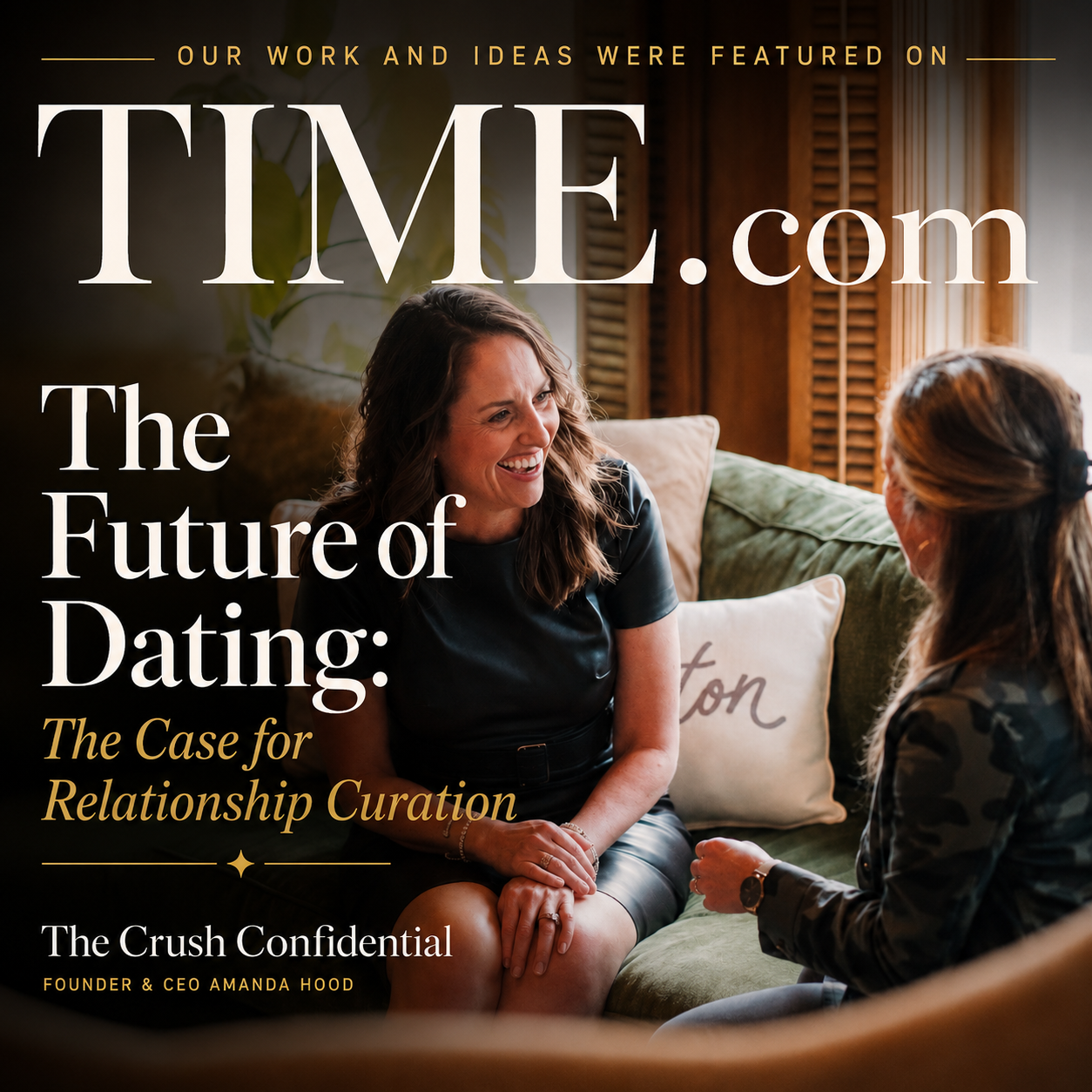
Featured in TIME: Why Relationship Curation Is the Future of Dating

The Crush Confidential was recently featured in TIME for our work in relationship curation. The piece examined a question that drives everything we do: why has dating become easier than ever, while relationships have become harder to build?

You can read the full feature here: The Future of Dating: The Case for Relationship Curation

Below is the short version, plus what it means for anyone currently dating.

Access Went Up. Clarity Did Not.

Technology solved the meeting problem. Apps put thousands of people in front of you. Social platforms extended your reach far past your zip code. That part works.

The part that never got solved is what happens after the introduction.

Most accomplished singles are not struggling to get a first date. They are struggling to turn a first date into a relationship. That gap is where the exhaustion comes from, and it is not a personal failing. It is a design flaw in how the entire industry operates.

Why Introductions Alone Are Not Enough

Traditional matchmaking has one output. Two compatible people meet, and the matchmaker steps back.

The assumption is that compatibility will surface on its own. In practice, it often does not. The first few weeks of a new connection are the most fragile stage of the entire relationship, and that is precisely the stage where most clients are left alone.

We built The Crush Confidential around a different conviction. Chemistry needs structure. That is what relationship curation provides.

What Relationship Curation Actually Means

Relationship curation means a relationship professional stays involved through the early development of the connection, not just the introduction.

In practice, that includes:

  • Interpreting communication patterns before they get misread

  • Managing expectations on both sides

  • Coaching clients through uncertainty instead of letting them guess

  • Providing real-time feedback between dates

The goal is not to force an outcome. The goal is to remove the avoidable friction that ends viable connections before they have a chance to become real.

The 3-Date Model

Our proprietary 3-Date Model is the framework behind this.

First dates are shaped by nerves and expectation. They tell you very little about how two people will actually relate to each other. By the second and third date, communication loosens, and the real signal appears.

Most modern dating culture pushes people to decide after one meeting. The 3-Date Model pushes back on that. When clients are guided through this phase rather than left to navigate it alone, premature endings drop significantly.

Ghosting Is a Skill Gap, Not a Character Flaw

Ghosting gets treated as a personality problem. We treat it as a structural one.

Digital communication made disappearing easier than having one uncomfortable conversation. Nobody was ever taught how to close a connection cleanly, so they default to silence.

Our clients learn how to handle early ambiguity directly. They also learn how to respond when it happens to them.

Better Matches, Better Daters

Every engagement at The Crush Confidential is tailored. There is no template.

Coaching is woven in from day one, because the objective is not only to introduce you to compatible people. It is to make you a stronger partner. Clients leave with sharper self-awareness and with dating patterns broken that had been quietly costing them for years.

The Future of Dating

Algorithms will keep improving. AI will keep optimizing profiles and predicting behavior.

None of that touches the part that actually determines whether a relationship survives: communication, timing, and the willingness to stay present through uncertainty. Those remain human. They also remain teachable.

That is the work.

If You Are Ready for Something Real

We work with commitment-minded singles nationwide who are done with apps and ready to date with structure.

Explore how we work: Work With Us

Not ready to become a client? Add your profile to our Singles Rolodex at no cost. It is how we source matches for our paying clients.

See the results: Our Success

Modern Dating Terms You Need to Know in 2025: A Guide to Today’s Relationship Language

Person looking at their phone while navigating modern dating apps and terminology.

Modern dating moves fast—and so does the language around it. New terms seem to pop up every time you open Instagram, TikTok, or your favorite dating app. As Amber Samuels, Ph.D., notes, this shared vocabulary creates connection and helps people make sense of the experiences they’re navigating.

At The Crush Confidential, where we guide singles through today’s ever-evolving dating culture, we see firsthand how helpful this modern “dictionary” can be. Below is your A-to-Z breakdown of the most popular dating terms in 2025—what they mean, why they matter, and how understanding them can improve your approach to love.


Affordating

Affordating refers to choosing low-cost or budget-friendly date ideas without compromising the quality of the experience. It reflects the growing trend toward mindful spending and intentional connection.


Benching

Benching happens when someone keeps a romantic interest “on the sidelines” while actively pursuing other people. They maintain occasional contact—just enough to keep the person interested—without committing to anything meaningful.


Breadcrumbing

Breadcrumbing involves sending minimal, inconsistent signals of interest (like sporadic texts or likes) to keep someone emotionally hooked without progressing toward an actual relationship.


Catfishing

Catfishing is when a person pretends to be someone else online by using fake photos or misleading information. This can range from minor image editing to creating entirely fabricated identities.


Conscious Uncoupling

Conscious uncoupling is a thoughtful, respectful approach to ending a relationship. It prioritizes clear communication, emotional closure, and reducing harm for both people involved.


Cuffing Season

Cuffing season describes the fall and winter months when many people seek temporary relationships or companionship. These connections may or may not last beyond the season.


DINK

DINK stands for “dual income, no kids” and refers to couples who both earn income and have chosen (temporarily or long-term) not to have children.


DTR

DTR means “define the relationship.” It’s the conversation where two people clarify what they are — dating, exclusive, serious, casual, or somewhere in between.


50/50

“50/50” is the debate about how equally partners should split finances, chores, and responsibilities in a relationship. The term often comes up when discussing fairness and expectations.


FLR

FLR stands for “female-led relationship,” where the woman takes a more prominent role in decision-making, finances, structure, or leadership within the relationship.


FWB

FWB, or friends with benefits, describes two friends who maintain a friendship while also engaging in physical intimacy without a romantic commitment.


Gaslighting

Gaslighting is a form of manipulation where one person causes the other to doubt their memory, perception, or reality. It often involves denial, blame-shifting, or trivializing emotions.


Ghosting

Ghosting is abruptly cutting off all communication without explanation. The person receiving the silence is left without closure, clarity, or understanding of what went wrong.


Green Flags

Green flags are positive signs — consistency, communication, emotional safety, reliability — that indicate someone has healthy qualities suitable for a relationship.


Hard Launch

A hard launch is a clear, public announcement of a new relationship on social media, typically revealing a partner’s face, name, or the relationship status directly.


The Ick

The ick is a sudden feeling of discomfort or repulsion toward someone you were previously interested in. It’s often triggered by a specific behavior or moment.


Love Bombing

Love bombing is overwhelming someone with affection, gifts, compliments, or attention early in dating. It can be genuine in rare cases, but often it is manipulative or rooted in insecurity.


Micro-Cheating

Micro-cheating refers to small behaviors that cross emotional boundaries, such as flirty messages, secret interactions, or maintaining dating profiles while in a relationship.


Negging

Negging involves giving someone backhanded compliments or subtle insults to undermine their confidence and increase their desire for approval from the person delivering them.


Orbiting

Orbiting is when someone ends communication but continues watching your stories, liking your posts, or engaging with your social media. They stay “in your orbit” without actual contact.


Red Flags

Red flags are warning signs that a person or relationship may not be healthy — disrespect, inconsistency, hot-and-cold behavior, poor communication, dishonesty, or boundary violations.


Rizz

Short for charisma, rizz describes someone’s ability to charm, flirt, or attract others through personality, confidence, or presence.


Ship

Short for “relationship,” to “ship” someone is to support or encourage two people becoming a couple — whether fictional characters or real individuals.


Situationship

A situationship sits between casual dating and a relationship — emotional or physical closeness without clear commitment, labels, or expectations.


Slow Fade

A slow fade is a gradual withdrawal of communication or effort instead of an abrupt ghosting. Messages become less frequent, plans decline, and interest fades without explanation.


Soft Launch

A soft launch is a subtle social-media reveal of a relationship, such as posting a partner’s hand, shoes, or a dinner date angle that hides their identity.


Soulmate

A soulmate describes someone with whom you share a deep emotional, romantic, or spiritual connection — often feeling natural, aligned, and meaningful.


Talking Stage

The talking stage is the early phase where two people get to know each other before committing. It can include texting, flirting, and early dates while deciding if a relationship is possible.


Twin Flame

A twin flame refers to an intense spiritual connection believed to represent two halves of the same soul — often passionate, challenging, and transformational.


Zombieing

Zombieing is when someone who ghosted suddenly reappears, acting as though nothing happened — resurfacing with a “Hey stranger” message or unexpected contact.

Final Thoughts

Modern dating comes with its own language, and knowing these terms isn’t just about staying current—it’s about understanding the emotional landscape of relationships today. When you can identify patterns like breadcrumbing, orbiting, or slow fades, you’re better equipped to protect your heart and advocate for what you truly want. And when you recognize green flags, healthy communication styles, and aligned values, you can move toward connection with confidence instead of confusion.

At The Crush Confidential, we see countless singles who feel overwhelmed by the complexities of dating culture—especially those navigating the endless loop of apps, situationships, and mixed signals. What many don’t realize is that modern dating language often reflects modern dating pain points. By naming the experience, you take back control of it.

Our mission is to guide you toward something far more meaningful than trendy terminology: real partnership, genuine compatibility, and the kind of connection that isn’t dependent on timing, swipes, or seasonal flings. Through thoughtful vetting, intentional matching, and ongoing support, we help our clients move out of uncertainty and into clarity. Whether you’re recovering from a zombie, tired of the talking stage, or ready to graduate from situationships altogether, you don’t have to navigate today’s dating landscape alone.

Love may evolve, but the desire for a deep, lasting relationship never goes out of style. If you’re ready for a more intentional, curated approach to dating—one rooted in values, alignment, and authenticity—The Crush Confidential is here to guide your journey every step of the way.